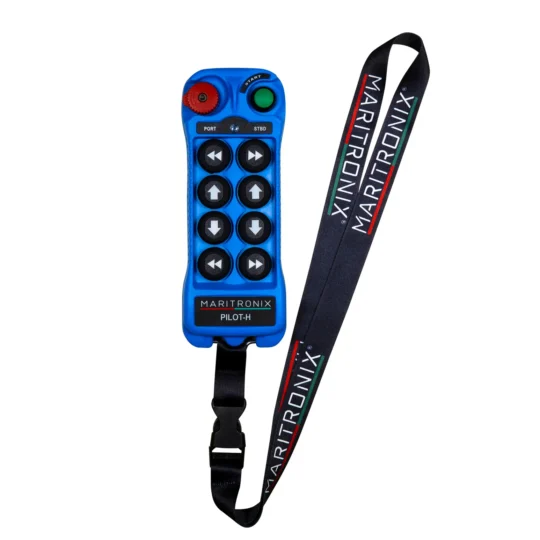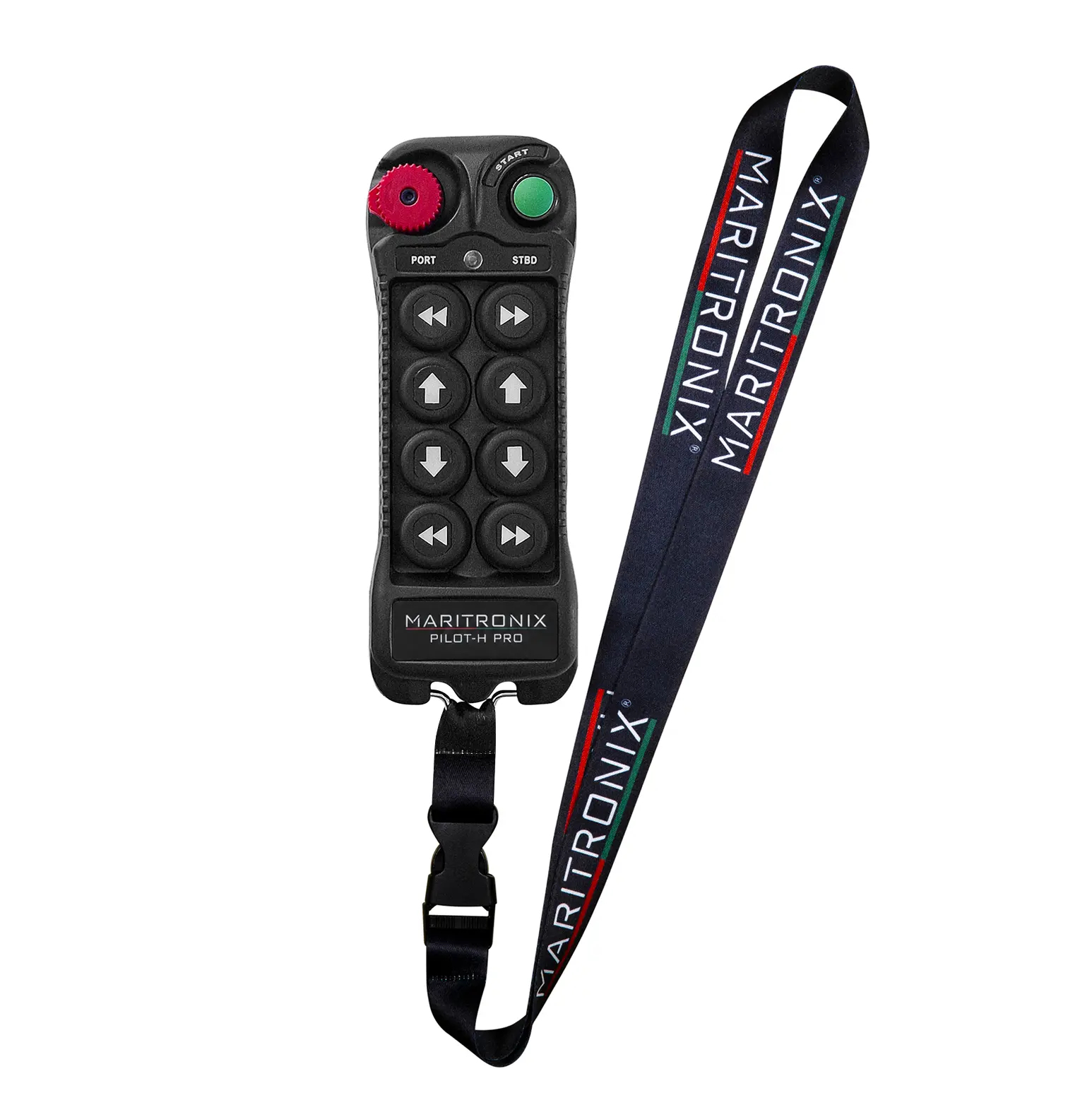
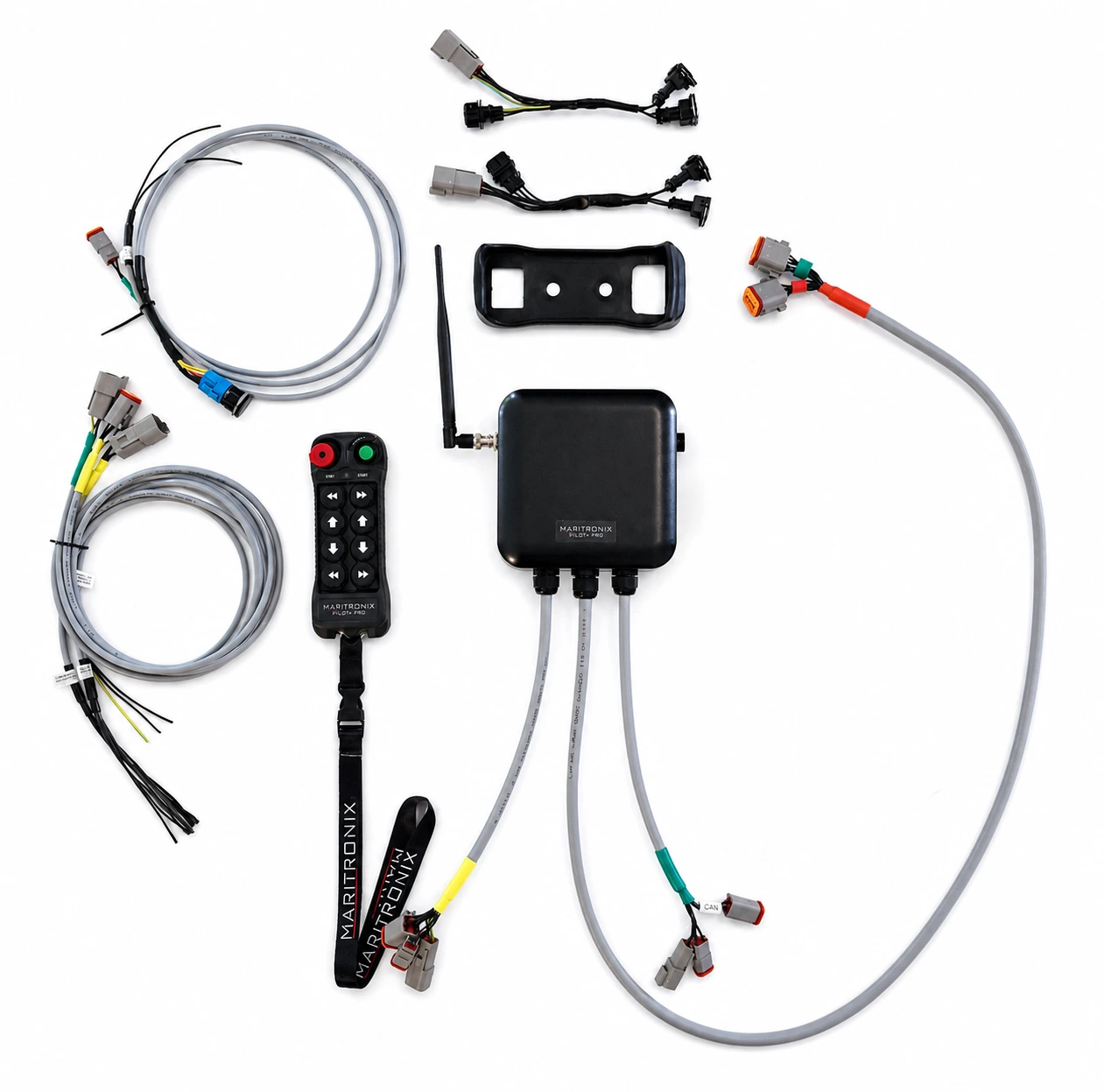
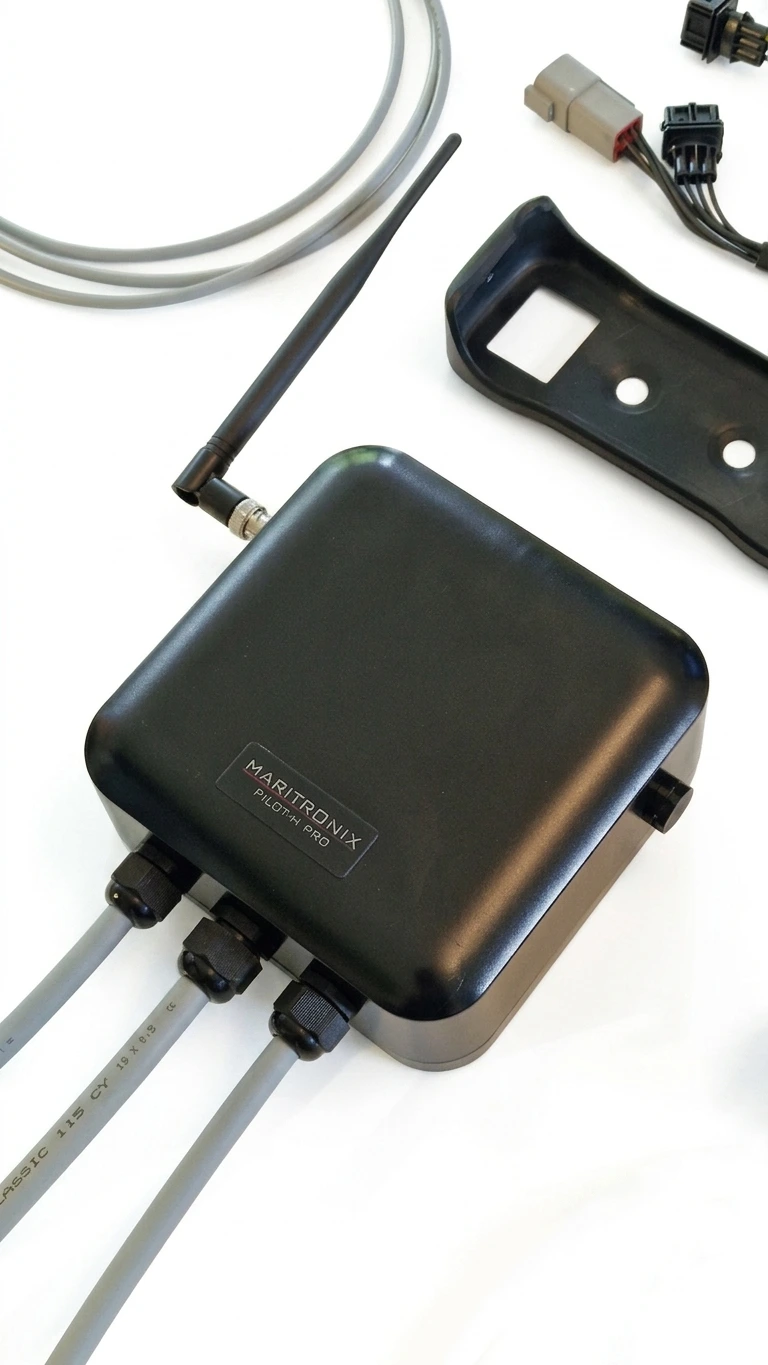

PILOT-H PRO is the advanced proportional version of the Maritronix PILOT-H wireless yacht
remote control system. It is designed for boat owners, skippers, yacht builders, installers,
boatyards, and marine professionals who require more precise low-speed control during docking,
undocking, anchoring, mooring, stern-to berthing, and close-quarters manoeuvring.
Compared with the standard PILOT-H system, PILOT-H PRO adds calibrated two-stage proportional
engine control. The first button step is typically used for smooth gear engagement at idle speed,
while the second button step provides a stronger calibrated thrust level when additional
manoeuvring power is required.
The PILOT-H PRO transmitter uses two-step engine-control buttons. Each engine button has two
pressure points, allowing the skipper to activate two calibrated proportional response levels with
the same button.
This makes PILOT-H PRO especially suitable for heavier yachts, boats with high windage,
tight marina spaces, stern-to berthing, wind correction, current correction, and situations where
simple gear-in / gear-out control is not enough.
Proportional Wireless Yacht Control for More Precise Manoeuvring
PILOT-H PRO is developed for situations where simple idle-speed engine engagement is not
always enough. During docking, stern-to berthing, side movement, wind correction, current
correction, anchoring, and tight marina manoeuvres, the skipper often needs more than one
engine response level.
The PRO version adds a calibrated two-stage proportional engine control function. The first stage
is typically used for smooth gear engagement at idle speed. The second stage can be configured
to provide a stronger engine response, for example idle plus an additional calibrated RPM value,
depending on the engine control system, gateway configuration, analog interface, and vessel setup.
This gives the skipper better control authority when manoeuvring the boat slowly and accurately.
It is especially useful for heavier boats, yachts with high windage, vessels with strong bow or
stern thrusters, and installations where more precise thrust control is required during low-speed
operation.
Two-Stage Proportional Engine Response
The main advantage of PILOT-H PRO is its calibrated two-stage proportional engine response.
Unlike a simple on/off wireless yacht remote control, PILOT-H PRO allows the skipper to command
two different engine-response levels from the same engine-control button.
The PILOT-H PRO transmitter uses two-step engine-control buttons. Each engine button has two
pressure points, allowing the skipper to activate two calibrated proportional response levels with
one button.
A normal press activates the first stage, typically used for smooth gear engagement at idle speed.
Pressing the same button further to the second pressure point activates the second stage, providing
a stronger calibrated engine response when additional manoeuvring thrust is required.
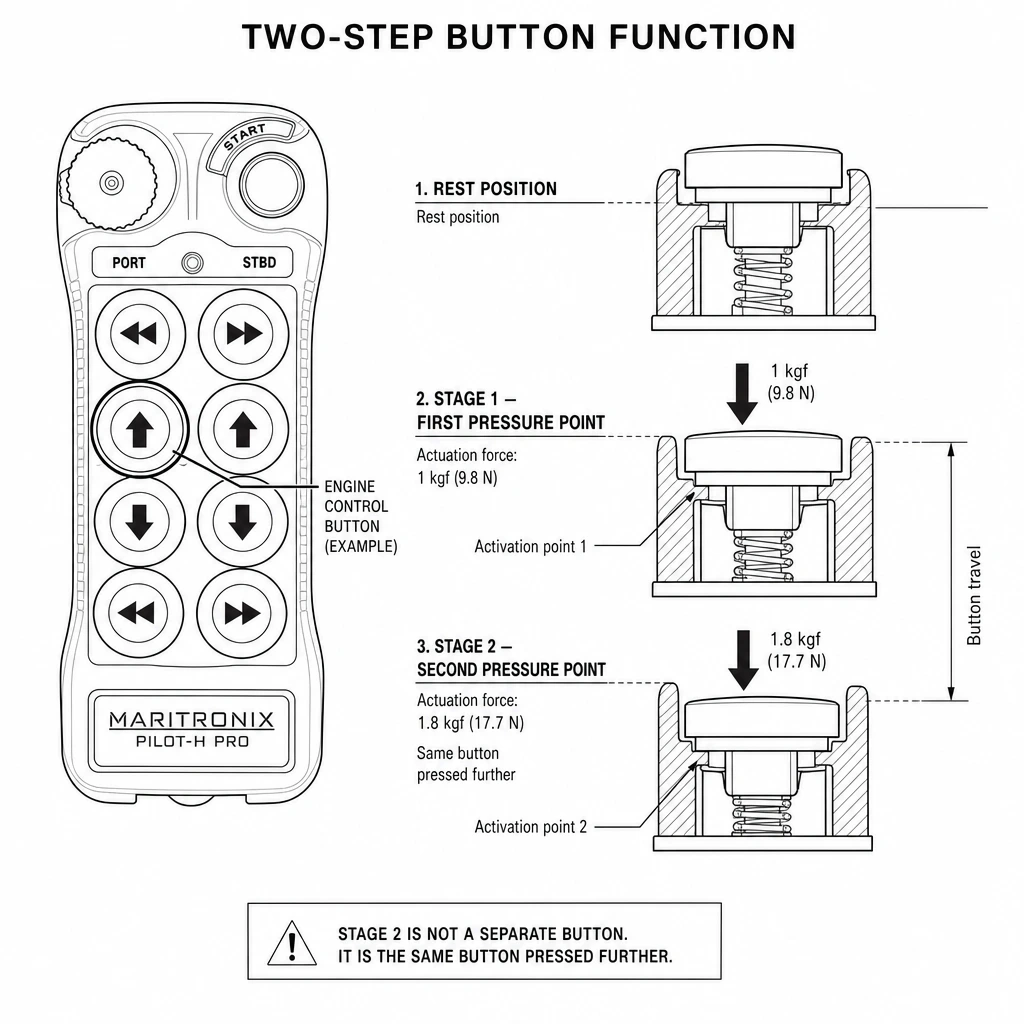
Stage 1: Activated by a normal press of the engine-control button, typically used for smooth idle-speed gear engagement.
Stage 2: Activated by pressing the same button further to the second pressure point, providing a stronger calibrated proportional engine response when additional thrust is required.
This two-stage proportional response is designed to give the skipper better control when moving
the boat slowly and accurately. It can help during docking in wind, correcting the boat’s position
near a pier, approaching a mooring line, manoeuvring in narrow marina spaces, or controlling the
boat from outside the main helm station.
The exact proportional response levels depend on the engine control system, throttle interface,
gateway type, analog signal interface, calibration, and vessel configuration. Before delivery,
Maritronix checks the installed throttle system, number of engines, control station layout, thruster
configuration, and available connection points to select the correct integration method.
PILOT-H PRO Transmitter Button Layout
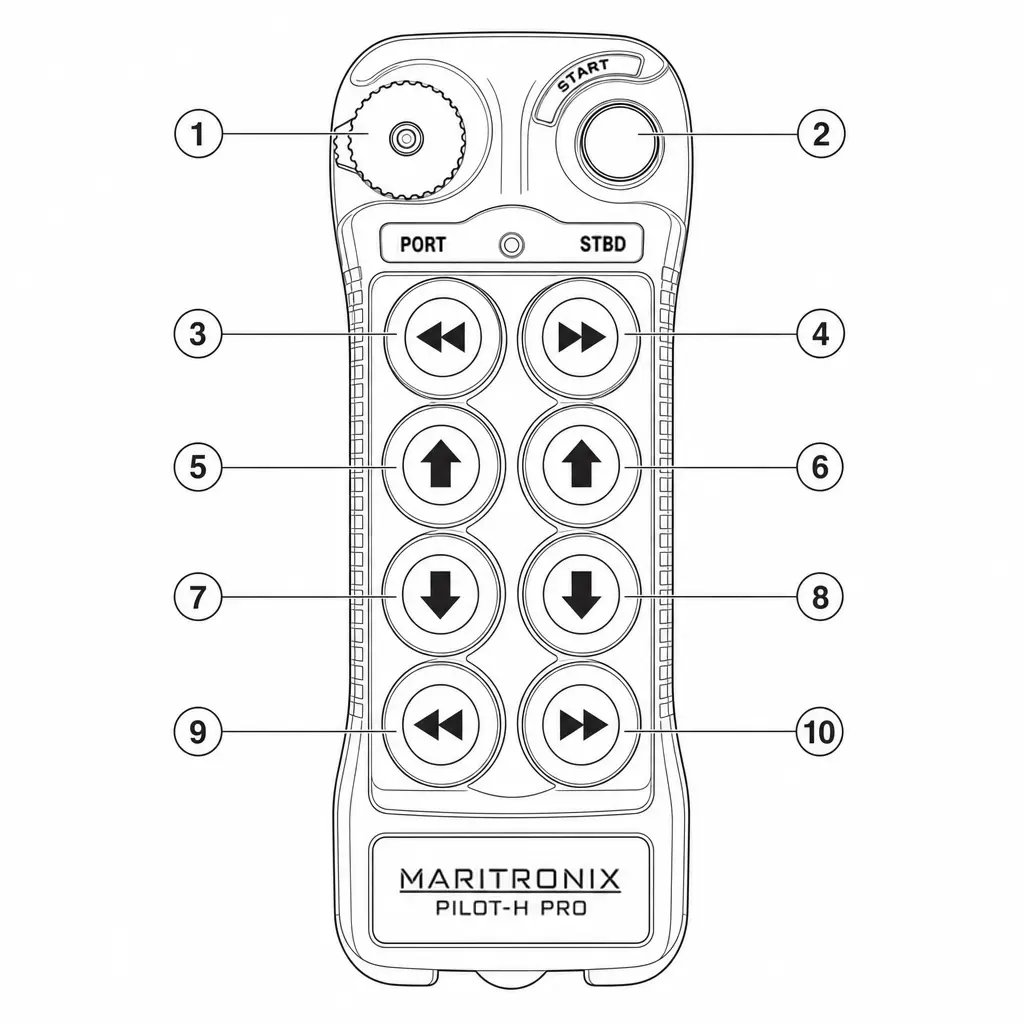
The numbered transmitter diagram shows the standard PILOT-H PRO button layout. The numbers are used
instead of printed function names so the same technical illustration can be used in different language
versions of the user manual and product documentation.
Depending on the selected system configuration, the PILOT-H PRO transmitter can control the main engines,
bow thruster, stern thruster, anchor windlass, horn, and additional configured functions. The exact button
assignment may vary depending on the vessel configuration and installed equipment.
| No. | Button / Control Function | Stage 1 | Stage 2 |
| 1 | STOP / OFF button | Turns off or stops the remote-control system. | Not applicable. |
| 2 | START button / function button | Activates the system. | Not applicable. This button may also be used as a function button for special combinations. |
| 3 | Bow thruster left | Bow thruster left, first response level. | Bow thruster left, second response level if supported by the installation. |
| 4 | Bow thruster right | Bow thruster right, first response level. | Bow thruster right, second response level if supported by the installation. |
| 5 | Port engine forward | Port engine engages forward gear at idle speed. | Port engine forward with higher preset RPM, calibrated during installation. |
| 6 | Starboard engine forward | Starboard engine engages forward gear at idle speed. | Starboard engine forward with higher preset RPM, calibrated during installation. |
| 7 | Port engine reverse | Port engine engages reverse gear at idle speed. | Port engine reverse with higher preset RPM, calibrated during installation. |
| 8 | Starboard engine reverse | Starboard engine engages reverse gear at idle speed. | Starboard engine reverse with higher preset RPM, calibrated during installation. |
| 9 | Stern thruster left | Stern thruster left, first response level. | Stern thruster left, second response level if supported by the installation. |
| 10 | Stern thruster right | Stern thruster right, first response level. | Stern thruster right, second response level if supported by the installation. |
For engine control, Stage 1 is typically used for smooth idle-speed gear engagement. Stage 2 provides
a stronger calibrated engine response by increasing RPM to a preset value selected during installation.
This allows the skipper to use gentle idle-speed manoeuvring or stronger thrust from the same button.
In a typical configuration, the anchor windlass can be controlled by pressing and holding the START
button and then pressing one of the bow thruster buttons. Holding button 2 together with button 3 or
button 4 can be used to raise or lower the anchor chain, depending on the selected installation
configuration.
The exact button assignment and Stage 2 behaviour may vary depending on the vessel configuration,
installed equipment, engine-control interface, thruster system, anchor windlass wiring, horn wiring,
and selected PILOT-H PRO setup.
Designed for Modern Electronic Marine Engine Control Systems
PILOT-H PRO is designed for integration with modern marine engine control systems, electronic
throttle and shift systems, CAN-Bus based control architectures, joystick-ready propulsion
systems, analog engine control systems, and engine-system-specific interfaces.
The system is not intended to replace the original engine control system. Instead, it is integrated
as an additional protected control interface. The original helm station, throttle handles, joystick
system, engine electronics, transmission control, diagnostic functions, and onboard safety logic
remain active where supported by the selected integration method.
PILOT-H PRO can be integrated with a wide range of marine engine control systems, including
Volvo Penta, Yanmar, Cummins, Mercury MerCruiser, MAN, Suzuki, Honda, Caterpillar, Yamaha,
ZF Marine, Twin Disc, Glendinning, NHK MEC, Dometic SeaStar, Kobelt, Flexball, Ultraflex,
and other compatible electronic or analog marine control systems.
Designed Not to Bypass Original Engine Control Logic
PILOT-H PRO is designed to work as an additional external control interface for yacht docking,
close-quarters manoeuvring, and proportional low-speed engine control. The system is not designed
to replace the original helm controls, throttle levers, joystick system, engine control unit,
transmission control system, or existing onboard safety functions.
Where compatible gateway modules, analog interfaces, or plug-and-play harnesses are available,
PILOT-H PRO can be integrated without bypassing the vessel’s original control architecture. This helps
preserve the original manufacturer control logic, diagnostic behaviour, service access, and normal
helm-station operation.
This approach is especially important on modern electronically controlled yachts, where engines,
gearboxes, joystick systems, helm stations, and propulsion control modules communicate through
dedicated control processors, CAN-Bus networks, or manufacturer-specific interfaces.
PILOT-H PRO Supported Engine Control Systems and Gateway Interfaces
PILOT-H PRO is not limited to one engine brand. The system can be integrated with a wide range of
marine engine control systems, electronic throttle and shift systems, throttle levers, joystick systems,
CAN-Bus based control architectures, analog control systems, and electronic propulsion control interfaces.
Depending on the vessel configuration, Maritronix can use original manufacturer interfaces,
manufacturer-specific connection interfaces, dedicated Maritronix gateway modules, CAN-Bus
interfaces, analog signal interfaces, or specially prepared plug-and-play connection harnesses.
For Volvo Penta installations, PILOT-H PRO can be adapted to compatible Volvo Penta EDC and EVC
control systems. For compatible EVC-E and newer systems, integration can be carried out through
original Volvo Penta TJS Gateway interfaces where supported by the vessel configuration. Compatibility
depends on the installed helm station, throttle controls, joystick system, software version, propulsion
layout, and available connection points.
| Manufacturer | Supported control system / throttle model | PILOT-H PRO integration interface | Integration status |
| Volvo Penta | EDC, EVC-B, EVC-C, EVC-D, EVC-E and newer EVC systems, EVC 2.0, EVC E4, compatible IPS and joystick-ready Volvo Penta systems | Maritronix interface / original Volvo Penta TJS Gateway interface where supported | Integrated by Maritronix depending on the installed Volvo Penta control system and vessel configuration |
| Yanmar | VC10, VC20, VC30 Vessel Control Systems | Yanmar VC Gateway / CAN-Bus Interface | Integrated by Maritronix for compatible Yanmar VC control systems |
| Suzuki Marine | Suzuki Precision Control, SPC 1.0, SPC 2.0 | Suzuki SPC Gateway / CAN-Bus Interface | Integrated by Maritronix for compatible Suzuki Precision Control systems |
| Mercury / MerCruiser | SmartCraft DTS, Digital Throttle & Shift, Next Gen DTS, Axius, Joystick Piloting systems | Mercury SmartCraft DTS Gateway Interface | Integrated by Maritronix for compatible Mercury and MerCruiser electronic control systems |
| Yamaha | Digital Electronic Control, Command Link Plus, Helm Master, Helm Master EX | Yamaha DEC / Helm Master Gateway Interface | Integrated by Maritronix for compatible Yamaha electronic control systems |
| Honda Marine | iST Intelligent Shift & Throttle | Honda iST Gateway Interface | Integrated by Maritronix for compatible Honda iST control systems |
| Cummins / Zeus | Cummins electronic controls, SmartCraft-based systems, Zeus joystick systems | Cummins / Zeus Gateway Interface | Integrated by Maritronix depending on the installed control system configuration |
| Caterpillar | Cat Marine electronic propulsion controls, MPC100, MPC300 | Caterpillar Marine Control Interface | Integrated by Maritronix depending on the installed control system configuration |
| MAN Marine | MAN iSea, MAN electronic engine control systems, MMDS-based systems | MAN Marine Control Interface | Integrated by Maritronix depending on the installed control system configuration |
| MTU / Rolls-Royce Power Systems | MTU BlueVision, BlueVision NG, mtu NautIQ control systems | MTU / NautIQ Control Interface | Integrated by Maritronix depending on the installed control system configuration |
| ZF Marine | MicroCommand, MicroCommander, ClearCommand, MiniCommand, CruiseCommand, SmartCommand, TotalCommand | ZF Electronic Control Interface / ZF Gateway Interface | Integrated by Maritronix for compatible ZF Marine electronic control systems |
| Twin Disc | Power Commander, EC300, EC300JS, Express Joystick System | Twin Disc Electronic Control Interface | Integrated by Maritronix for compatible Twin Disc electronic propulsion control systems |
| Glendinning | Complete Controls, EEC-3, EEC-4, Smart Actuator systems, ProPilot | Glendinning Complete Controls Interface | Integrated by Maritronix for compatible Glendinning control systems |
| NHK MEC | KE-4XG, KE-5XG, KE-6+, KE-7+ electronic engine controls | NHK MEC Electronic Control Interface | Integrated by Maritronix for compatible NHK MEC electronic control systems |
| Dometic / SeaStar | i7700, i7800, Optimus 360 joystick and electronic steering/control systems | Dometic / SeaStar Control Interface | Integrated by Maritronix depending on the installed control system configuration |
| Kobelt | Kobelt electronic marine engine control systems | Kobelt Electronic Control Interface | Integrated by Maritronix depending on the installed control system configuration |
| Flexball / Ultraflex | Flexball and Ultraflex electronic throttle and shift control systems | Flexball / Ultraflex Control Interface | Integrated by Maritronix depending on the installed control system configuration |
The table above shows the most common marine engine control systems supported by PILOT-H PRO.
For the complete and up-to-date list of supported throttle handles, electronic control systems,
joystick systems, analog interfaces, and gateway interfaces, please download the full supported
controls list.
Compatibility depends on the exact engine control model, software version, helm station layout,
number of engines, joystick system, thruster configuration, available connection points, and the
required PILOT-H PRO two-stage proportional engine-response configuration. Before delivery,
Maritronix checks the installed throttle handle, joystick, control processor, engine interface,
bow thruster, stern thruster, and anchor windlass controls to select the correct PILOT-H PRO
integration method.
Warranty-Conscious and Seamless Gateway Integration
For modern electronic propulsion systems, PILOT-H PRO can be integrated through dedicated
Maritronix gateway modules. These gateways provide a safe, reliable, and engine-system-specific
interface between the PILOT-H PRO system and the original engine control architecture.
The gateway integration is designed to preserve the original engine control architecture and support
warranty-conscious installation when the system is installed correctly according to the applicable
installation requirements. The integration method is designed to avoid unnecessary modification of
the original engine control network.
The gateway acts as a protected interface between PILOT-H PRO and the original engine control
system. It separates the wireless control system from the engine electronics and other onboard
control components, while keeping the original manufacturer system unchanged.
As a result, the original engine control system can continue to operate normally. The integration
method is designed to help prevent unnecessary alarms, fault codes, diagnostic errors, or
interference with the original diagnostic and safety functions.
Authorized engine dealers and service technicians can continue to diagnose, maintain, and service
the engine system using the standard manufacturer tools and procedures, just as they would on
a vessel without PILOT-H PRO installed.
Careful Handling of Analog Engine Control Signals
For vessels equipped with analog engine control systems, PILOT-H PRO is designed to handle analog
signals with particular care and precision. Instead of generating simple PWM-based control signals,
the system uses true analog signal-producing components to provide smooth and stable command
outputs for the engine control interface.
High-speed electronic components, dedicated signal filtering, and continuous signal monitoring
help ensure clean, stable, and predictable control behaviour. This careful analog signal architecture
reduces the risk of unwanted engine control errors, signal noise, or unstable throttle behaviour.
In compatible analog installations, PILOT-H PRO can also support calibrated two-stage engine
response, allowing the skipper to use a low-speed first stage and a stronger second-stage response
where the vessel configuration allows it.
Compact Receiver for Easy Installation in Modern Helm Stations
The PILOT-H PRO receiver is designed to be compact and easy to install, even in modern helm
stations where free space behind the dashboard, control panels, or electrical compartments is
often limited.
With dimensions of only 160 × 160 × 70 mm, the receiver can be installed in many
helm areas without requiring large modifications or additional installation space. This compact
size is especially useful on newer boats and yachts, where the space behind the helm is often
occupied by displays, control modules, wiring harnesses, navigation electronics, joystick systems,
switch panels, and engine-control components.
The compact receiver design helps make the installation cleaner, faster, and easier while still
providing the industrial-grade safety architecture, wireless control logic, gateway integration,
and connection flexibility required for professional marine installations.
Simple Plug-and-Play Installation
PILOT-H PRO is engineered for clean and straightforward installation. Each system can be supplied
with a detailed installation manual and plug-and-play connectors prepared individually for the
specific engine control system and vessel configuration.
For many supported engine control systems, PILOT-H PRO can be supplied with prepared connection
harnesses, gateway modules, analog interfaces, or plug-and-play interface cables. This allows a clean
and reversible installation while reducing the need for unnecessary cutting, splicing, or modification
of the vessel’s original wiring.
No programming skills, special diagnostic cables, external software, or mobile apps are required
for normal setup. The installation process is clear, practical, and designed for professional marine
electricians, installers, boatyards, and experienced boat owners with basic electrical knowledge.
The system is designed to be installed without changing the normal operation of the original
helm station. The boat can still be controlled from the original throttle handles, original joystick,
and standard helm controls where supported by the selected integration method.
Built-In Configuration and Installation Wizard
PILOT-H PRO includes a built-in configuration interface and installation wizard. The setup process
guides the installer through the most important configuration steps, helping to reduce installation
time and avoid unnecessary complexity.
Configuration and monitoring functions are accessible from any Wi-Fi-capable device using a
standard web browser. No dedicated mobile app, special PC program, license key, diagnostic
cable, or external programming tool is required for normal configuration.
This browser-based approach improves long-term serviceability. The system remains independent
from app-store availability, mobile operating system updates, discontinued software, or special
programming tools. This is especially important for marine systems that are expected to remain
serviceable for many years.
Industrial-Grade Safety Architecture
PILOT-H PRO is developed with a strong focus on operational safety. The system uses an
industrial-grade architecture with redundant control logic and high-quality electrical components
suitable for demanding marine environments.
The system incorporates two independent microcontrollers. Each control path uses two independent
relays connected in series. This safety-oriented design helps reduce the risk of unintended output
activation and supports reliable operation in professional marine installations.
PILOT-H PRO uses a powerful coded wireless signal combined with a Hamming-code-based
transmission method. This communication principle is designed to provide strong resistance
against radio interference and help prevent unintended activation from external radio signals.
Before shipping, every PILOT-H PRO system is individually tested for wireless operation. The
standard operating range is up to 100 meters. Under open-area conditions, the system may reach
significantly longer distances, up to approximately 500 meters, depending on the environment,
antenna position, installation conditions, and surrounding obstacles.
An emergency stop button designed with reference to ISO 13850 emergency-stop principles is
included as part of the system.
Reliable Marine Transmitter and Receiver
The PILOT-H PRO transmitter is designed for demanding marine use. The transmitter enclosure
is rated IP65 and is buoyant in water, helping protect the device in wet and exposed environments.
The transmitter is powered by two AA batteries and is designed for long operating time without
charging. Depending on usage conditions, the batteries can provide up to 12 months of operation.
An LED on the transmitter indicates battery status.
The receiver is built in a robust industrial polycarbonate enclosure. Status LEDs on the receiver support
fast troubleshooting, installation checks, and system diagnostics.
Remote Docking Control from the Best Position on Board
During docking, mooring, stern-to berthing, anchoring, or single-handed manoeuvring, the best
view is often not from the main helm seat. PILOT-H PRO allows the skipper to control selected yacht
functions from a more practical position on board, such as the aft deck, side deck, swim platform,
or bow area, depending on the vessel and operating situation.
The system can control the main engines, bow thruster, stern thruster, anchor windlass, and horn,
depending on the selected configuration. This gives the skipper better visibility of the quay,
pontoon, mooring lines, anchor position, and surrounding obstacles during close-quarters yacht
handling.
For twin-engine vessels, PILOT-H PRO can support precise low-speed manoeuvring by allowing the
operator to command port and starboard engine functions separately. With calibrated two-stage
engine response, the skipper can use a gentle first stage for fine positioning and a stronger second
stage when additional thrust is required.
Optional Docking Joystick for PILOT-H PRO
PILOT-H PRO can be combined with an optional Maritronix docking joystick. The joystick gives
the skipper a more natural and intuitive way to control the yacht during close-quarters manoeuvring.
Instead of pressing separate engine and thruster buttons, the joystick can be used to command
the desired movement direction of the boat, depending on the installed system configuration.
The joystick option is especially useful for twin-engine boats with bow and stern thrusters.
It allows more comfortable control during side movement, diagonal correction, rotation, stern-to
berthing, and precise marina manoeuvres. For PILOT-H PRO installations, the joystick can also
make better use of the two-stage proportional engine-response logic.
Depending on the vessel configuration, the joystick can control the engines, bow thruster,
stern thruster, or a combination of these functions. Maritronix checks each boat configuration
before delivery to select the correct control logic and integration method.
PILOT-H Standard vs PILOT-H PRO
The standard PILOT-H system is designed for reliable wireless control of engines, bow thruster,
stern thruster, anchor windlass, and horn. It is ideal for users who need a robust wireless
docking remote with safe gear-in / gear-out functionality.
PILOT-H PRO is designed for users who want more advanced engine control. It adds a calibrated
two-stage proportional engine response for more precise low-speed manoeuvring. This makes the
PRO version the preferred solution for boats where more precise thrust control is required.
| Feature | PILOT-H Standard | PILOT-H PRO |
| Engine control | Standard gear-in / gear-out control | Calibrated two-stage proportional engine response |
| Button operation | Single-step engine-control buttons | Two-step engine-control buttons with two pressure points |
| Low-speed manoeuvring | Idle-speed control | Idle-speed plus calibrated stronger thrust level |
| Best use case | Docking, anchoring, basic wireless control | More precise docking, wind correction, current correction, heavier vessels |
| Joystick option | Optional | Optional |
| Configuration | Browser-based setup | Browser-based setup |
Why Choose PILOT-H PRO?
PILOT-H PRO is designed for yacht owners, skippers, installers, boatyards, and marine professionals
who want more than a basic wireless docking remote. It combines calibrated two-stage proportional
engine response, two-step engine-control buttons, optional joystick control, gateway-based
integration, analog signal handling, browser-based configuration, coded radio communication,
compact receiver design, and industrial-grade safety architecture in one professional system.
The system is especially useful during docking, undocking, anchoring, mooring, stern-to berthing,
single-handed manoeuvring, side movement, narrow marina operation, and situations where the
skipper needs better visibility from outside the main helm station.
For many modern yachts and motorboats, PILOT-H PRO provides a professional solution for
wireless yacht control with more precise engine response than standard on/off remote systems.
It is the preferred version for users who want smoother control, stronger manoeuvring authority,
and better adaptability to different vessel sizes and propulsion configurations.
Please contact Maritronix with photos of your throttle handle, helm station, engine control system,
joystick system, bow thruster, stern thruster, and anchor windlass controls. Maritronix will check
the configuration and help select the correct integration method for your vessel.